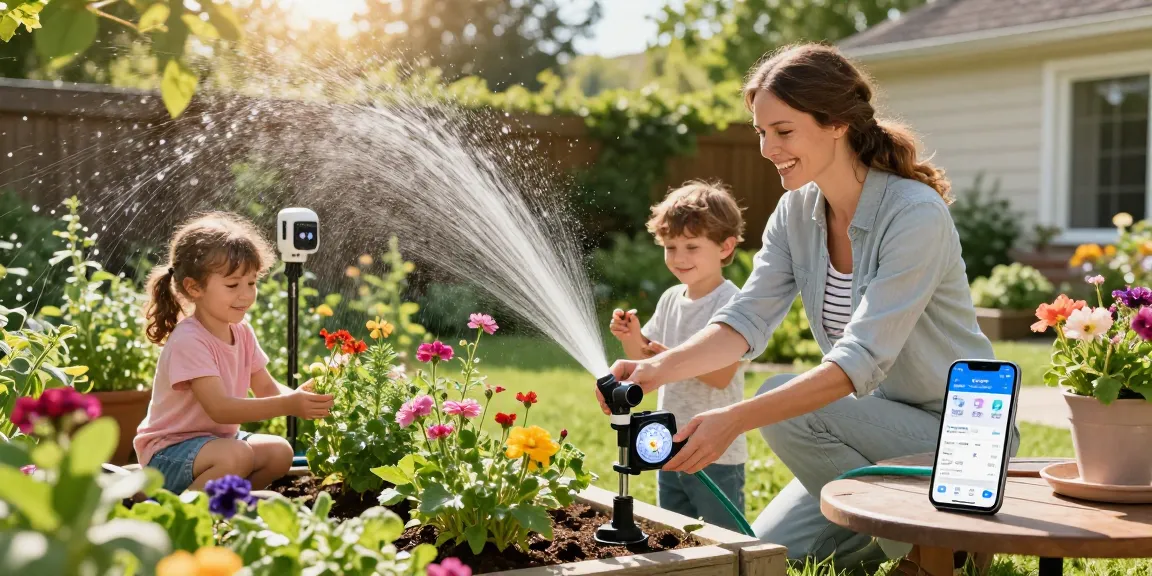
Mark, a homeowner in suburban Ohio, woke up one July morning to brown patches across the front lawn despite watering every evening. He’d been hand-watering with a hose because his old timer ran at fixed times and his sprinklers oversprayed the sidewalk. Mark needed a plan that matched his yard’s soil, slope, and schedule—not a one-size-fits-all routine. This article maps common lawn problems to specific setups so you can follow a lawn watering schedule that actually works for your yard.
Diagnose the problem: Why your current schedule fails
Before changing watering times, identify the real issue. Is water running off a slope? Are sidewalks getting soaked while turf stays dry? Do you have clay soil that holds moisture but resists infiltration, or sandy soil that drains quickly? Each of those problems requires a different fix.
Common challenges and what they reveal
- Water running off the lawn within minutes → Infiltration rate too low (often compacted or clay soil).
- Evening puddles on low spots, plus soggy roots → Overwatering or poor drainage.
- Dry soil despite frequent short watering → Shallow watering; roots are shallow and stressed.
- Patchy green, patchy brown → Uneven coverage or different soil types across the yard.
Practical example: A 5,000 sq. ft. lawn with clay soil and a 6% slope will need shorter, repeated cycles (cycle-and-soak) to avoid runoff. University extension services recommend breaking a normal watering event into multiple passes so water has time to soak in—this prevents wasted water and encourages deeper roots.
Match the right setup to the problem: systems that work
Pair the challenge with an irrigation solution. The goal is consistency and efficiency—getting water into the root zone without waste. Below are scenario-based pairings to guide your choices.
Small lawn or rental yard: mobile sprinklers and manual timers
Problem: You have a small front yard or move frequently, so permanent irrigation isn’t practical. Solution: Use a mobile sprinkler setup with a programmable outdoor timer and a small soaker hose for beds. This keeps costs low and control high. For a 500 sq. ft. lawn in sandy soil, two 20-minute sessions per week might be enough during peak summer, split into two 10-minute cycles to allow infiltration.
Large lawn: smart in-ground systems
Problem: Large lawns are getting watered inefficiently because manual schedules don’t consider weather. Solution: A smart controller with zones that match turf, beds, and slopes. A WiFi timer such as the RainPoint model lets you set weather-based adjustments and run multiple short cycles for erosion-prone areas. According to the EPA, smart irrigation controllers can save homeowners up to 8,000 gallons per year compared with conventional controllers (EPA WaterSense), and some studies cite even larger savings depending on climate and system quality.
Vegetable gardens and flower beds: precise root-zone watering
Problem: Beds dry out between watering or get soggy at the surface while roots remain dry. Solution: Drip lines or soaker hoses placed at the root zone. A complete drip kit delivers water slowly so roots absorb it; for example, a tomato bed may need 1–1.5 inches of water per week in mid-summer, delivered in three sessions to maintain even moisture without encouraging foliar disease.
Design a schedule: frequency, duration, and timing
A reliable schedule balances how often you water with how long to run each zone. Focus on delivering 1 to 1.25 inches of water per week for cool-season grasses in peak summer and 1 to 1.5 inches for warm-season grasses. But don’t just set a clock and forget it—use soil checks and local evapotranspiration (ET) to tune the plan.
Practical scheduling rules
- Water early: run zones between 4–8 a.m. to reduce evaporation and disease risk.
- Cycle-and-soak: split runs into 2–3 short cycles spaced 30–60 minutes apart on slopes or clay soils.
- Measure: use a tuna-can test (place cans across the lawn) to see how long it takes to collect 1/2 inch; double that time for a 1-inch target.
- Adjust for season and rain: reduce frequency during cool, wet periods and increase slightly during heat waves.
Example schedule table for a 1,000 sq. ft. lawn (typical rotor heads collecting 0.25 inch per 15 minutes):
Soil typeFrequency (summer)Run time per cycleSandy3× per week20–25 minutes (single cycle)Loam2–3× per week25–30 minutes (single cycle)Clay2× per week15 minutes × 2 cycles (cycle-and-soak)
Real figure: Extension programs often recommend watering deeply and infrequently to develop strong roots; for many lawns that means about 1 inch per week rather than daily shallow sprays.
Troubleshooting and fine-tuning: signs your schedule needs change
Even a good schedule needs occasional tuning. Watch for these signs and match them to the right fix.
Symptoms and quick fixes
- Brown tips but moist soil below 1 inch: turf may be heat-stressed—add a short midday mist or increase deep watering once weekly.
- Wide, wet rings near sprinkler heads: heads misaligned or pressure too high—adjust nozzles or install a pressure regulator.
- New construction or compacted areas not absorbing water: aerate the lawn and use shorter repeated cycles until infiltration improves.
Concrete example: If you notice damp soil for 24+ hours after watering, reduce frequency or run time. Overwatering invites disease and wastes water; the EPA notes that correcting overwatering and using efficient equipment can significantly cut household outdoor water use—something many homeowners don’t realize.
For homeowners who want an easy path to a dependable plan, a clear, actionable guide helps. If you want step-by-step timing and zone recommendations tailored to your yard, consider resources that show how to follow a lawn watering schedule that actually works—the kind of guide that tells you exact cycle lengths by soil and sprinkler type so you don’t guess.
Implementing automation: pick the controller for your needs
Automation is about matching the controller to your yard. Don’t just buy the fanciest model; pick features that solve your problems. If you have microclimates and many zones, a WiFi smart controller with weather-based adjustments is worth it. If you rent or have a tiny yard, a basic programmable timer plus a soaker hose may be the best budget option.
A WiFi timer from RainPoint can handle weather-based adjustments and run multiple short cycles for slope areas automatically. For example, setting a smart controller to reduce runtime by 30% after a rainy day and to split runs for clay sections saves both water and hassle—some homeowners report annual savings of several thousand gallons depending on lawn size and local climate.
Practical setup example: For a 3-zone lawn (front turf, back turf with slope, flower beds), program the controller so turf zones run early morning twice per week with cycle-and-soak on the slope, and the flower-bed zone runs drip irrigation three times per week for 30 minutes. Monitor soil moisture for the first month, then trim runtimes by 10–15% if you see consistently wet profiles.