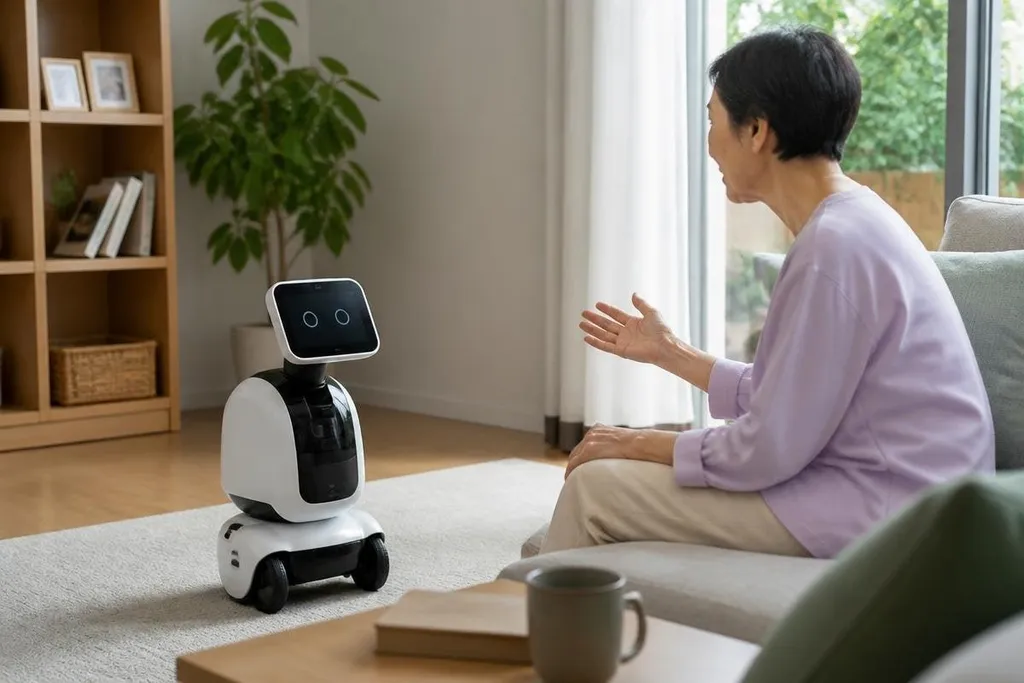
AI is changing companion robots in one clear area: conversation. Speech recognition, language models, and computer vision let a robot respond to words, notice objects, and keep track of more context than older scripted systems could manage.
That progress matters if you want a robot that can answer questions, remind someone about a task, or react to a room. It still doesn't prove that the robot understands a person or can act safely without close limits.
- Better conversation: language models let the robot handle more natural requests.
- More context: cameras and microphones help it connect speech with what is happening nearby.
- Open limits: good replies don't prove sound judgment or safe action.
Conversation replaces fixed scripts
Older companion robots relied on set phrases and narrow commands. A person had to use the expected words, and the robot had few ways to handle a reply outside that script.
AI changes the input layer. Speech recognition turns spoken words into text, while a language model picks a response from the conversation. The robot can also use stored details, such as a name or a preferred routine, when its software allows that memory.
The practical gain is less work for the person using it. You can ask for a reminder in ordinary language instead of learning a command list. The trade-off is that a fluent answer can hide a wrong guess.
Sensors give the robot more context
Conversation becomes more useful when the robot can connect words to its surroundings. Computer vision can help it identify an object, track a person, or read a simple visual cue. Microphones can help it estimate where a voice came from.
That information gives the software more to work with, but sensors don't create judgment by themselves. A camera may show a cup on a table; it doesn't tell the robot whether the cup is safe to move, belongs to someone else, or contains hot liquid.
This is where companion robots differ from chat software. A robot can affect the physical room. Its actions need limits around movement, personal space, household objects, and sensitive information.
Memory can make interaction feel personal
A companion robot becomes easier to use when it remembers details across sessions. It might store a preferred wake-up time, a name, or a request to avoid a certain topic. That memory can reduce repeated instructions and make the robot feel more consistent.
Memory also creates a data question. The system needs a clear way to view, change, and delete stored details. A person should know when the robot is listening, what it records, and which features work without a network connection.
An AI companion’s memory claim needs a record of the robot, the data it stores, and the controls a person gets. For product comparisons, Robot24.com puts those claims beside named machines, products, and research, so you can check whether a warm exchange matches the system behind it.
That context matters here because a smooth conversation tells you less than the robot's actual sensors, software limits, and physical actions.
The hard part is safe action
A language model can suggest an answer without having a reliable model of the room. The robot still needs rules for speed, force, distance, and access. It also needs a safe response when speech recognition fails or the software receives an unclear request.
A companion robot that only speaks has a smaller risk range than one that moves objects or follows people. Buyers should judge the physical system, the data settings, and the service plan together. A pleasant voice can't repair weak safety controls.
I'd skip any product that treats fluent conversation as proof of understanding. Ask what the robot can sense, what it can move, where its data goes, and how a person can stop it.
A practical buying check
Use this list before choosing a companion robot:
- Test the room: check whether the robot works in the lighting and noise levels where it will sit.
- Read the data settings: find out what audio, video, and conversation records are stored.
- Check physical limits: look for speed, force, obstacle detection, and an easy stop control.
- Ask about failure: learn what happens after a lost connection, wrong command, or sensor error.
- Confirm the cost: include the robot, software plan, repairs, and any required cloud service.
AI has made companion robots easier to talk with, and that is a real change in daily use. The next test is harder: whether these systems can act safely and usefully in homes without making people manage every step.